


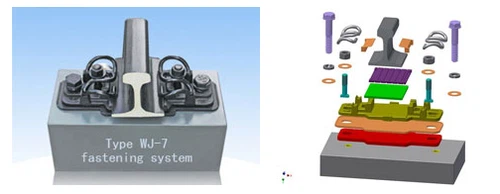
WJ-7 Rail Fixing System Pre-Installation Steps:
(1) : Install a 6mm-thick insulating cushion plate, ensuring its holes align with those of the embedded sleeves.

(2) : Place the baseplate with the rail base slope oriented toward the inner side of the track. The center of the baseplate bolt holes must align with the center of the embedded sleeves.

(3) Placing the Flat Spacer: Position the flat spacer on the baseplate with the longer side of the spacer facing inward relative to the center of the circular hole.
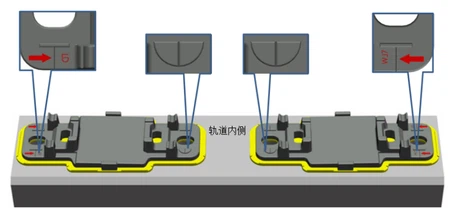
(4) Placing Heavy-Duty Spring Washer and Anchor Bolt: Fit the anchor bolt with the spring washer, first hand-tighten them into the embedded sleeve. Before fully tightening the anchor bolt, adjust the position of the baseplate to align the outer mark line on the baseplate with the mark line on the flat spacer. Then, preliminarily secure the anchor bolt using a torque-controlled wrench or tool with a torque of 100–150 N・m.

Fit the spring washer and screw it into the embedded sleeve, then tighten with a torque of 100-150 N·m.
On-Site Final Installation Steps:
(1) Laying the Rail Pad: After removing debris from the baseplate rail seat, position the rail pad correctly on the baseplate rail seat, ensuring it aligns with the specified orientation.
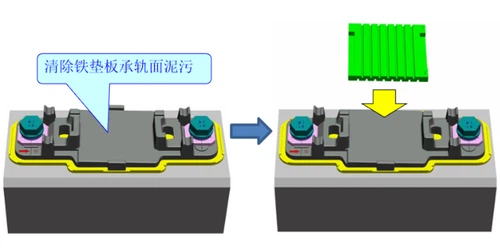
(2) Placing the Rail: Clean the top and bottom surfaces of the rail base thoroughly, then place the rail gently and securely in the center of the rail pad.

Remove mud and debris from the upper and lower surfaces of the rail base.
(3) Installing the Insulating Block: Carefully place the No. 9 insulating block between the rail and the baseplate shoulder. Avoid any violent impact during installation, and ensure full contact between the insulating block and the rail surface. If the gap between the insulating block and the baseplate shoulder exceeds 1 mm, promptly replace it with a No. 10 insulating block.

(4) Installing the T-bolt: After lubricating the threaded part of the T-bolt, insert its head into the slot of the baseplate and rotate it 90 degrees clockwise.

(5) Installing the Clip: Place the two supporting points at the rear end of the clip into the grooves on the two supporting platforms of the baseplate, ensuring the front end presses firmly against the insulating block.

(6) Install the flat washer and nut, and fasten the clip: Place the flat washer and nut in sequence. Lift the T-bolt upward, hand-tighten the nut, ensure the bolt is vertically aligned, and then use a torque-controlled wrench or tool to tighten the nut until the clip is properly seated.

(7) Tightening the Anchor Bolt: After confirming the track gauge and alignment are correct, use a torque-controlled wrench or tool to tighten the anchor bolt to a torque of 300–350 N・m. This completes the entire installation process.

Anchor bolt installation torque: 300-350 N·m.
Critical Post-Installation Maintenance Adjustments
Completion of fastener installation does not signify the end of the process. Subsequent steps require a series of meticulous and scientific operations, including track gauge and alignment adjustments, fastening condition inspections and adjustments, and rail elevation modifications. These measures ensure perfect integration of the fasteners with the track system, guaranteeing the safety and efficiency of railway operations.
As a critical component of high-speed rail track systems, the WJ-7 fastening system, with its precise composition and rigorous installation procedures, serves as a fundamental cornerstone for the safe and stable operation of high-speed railways.
